
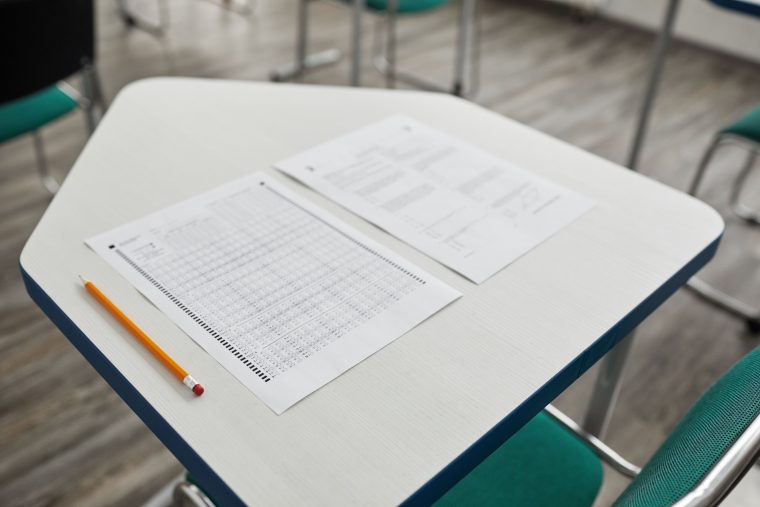
Lakhs of aspirants prepare for government exams every year, but only a few percentages of them clear it. Selection or rejection: It is not only about how much you have studied but also how well you can perform in real exam conditions. This is the exact point where Government Exam Mock Tests can make the most difference.
Practice papers are not mock tests. They are a systematic way of practicing the actual exam, finding out weak areas and building up the speed and accuracy needed to clear the cutoff in reality. In this article, we will discuss how taking mock tests regularly can improve your score and how to review each test correctly.
Why Mock Tests Matter More Than You Think
Many students spend months reading theory and revising notes but leave mock tests to the last few weeks. That’s not true. Government Exam Mock Tests serve a completely different purpose than regular study – they train you for performance, not just knowledge.
How regular practice of mock tests helps in your preparation:
1. It Reveals Your Actual Preparation Level
Reading a topic and being able to answer a timed question on it are two different skills. Mock tests show you, honestly, where you stand — not where you think you stand.
2.It Builds Real Exam Temperament
Government exams are as much a test of composure as they are of knowledge. Sitting for a full-length mock test repeatedly trains your mind to handle exam pressure, tricky questions, and time constraints without panicking.
3.It Highlights Recurring Mistakes
When you attempt one test, you might make a mistake and move on. When you attempt fifteen tests and track your errors, patterns emerge — a weak topic, a habit of misreading questions, or a tendency to rush certain sections.
How Mock Tests Help You Analyze Mistakes
The value of a mock test is not in taking it, but in reviewing it. Most aspirants take a test, look at their score, move on, never asking themselves why they got a question wrong.
Mistakes tend to be in one of the following categories:
- Conceptual gaps – you had no idea of the concept
- Silly mistakes – you knew the answer but misread the question or misjudged
- Wrong guess, you picked a question you should have skipped
- Time-pressure errors – you were rushing and made a mistake you didn’t need to
When you start tagging your mistakes like this, over several mock tests you will find that a large part of your lost marks is often due to silly errors and time pressure, not lack of knowledge. “Once you know that’s going on, that’s an easy, high-impact fix.
How Mock Tests Improve Accuracy
- Accuracy matters more than speed in government exams as most exams are negative marking. Regular practice of mock test improves accuracy in some tangible ways:
- You figure out what questions to leave out With time, you get a feel for which questions are traps and which are actually solvable.
You cut down on screw-ups. Doing exam type questions over and over trains you to read carefully and check your calculations twice. - You update your confidence. You learn to differentiate between “I am sure” and “I am guessing” which directly cuts down negative marking losses.
- How Mock Tests Increase Speed
- Speed is a skill, and all skills get better with repetition. Routine Mock Tests:
- You learn to read and understand patterns in questions faster.
- You can memorize shortcuts and formulas well enough that you can use them immediately, without having to stop and remember them.
- You get a sense of timing in there, and you know when to move on from a question.
- Most students experience a natural, measurable decline in the time they take per section after several attempts, without sacrificing accuracy, simply because the format becomes familiar.
How Mock Tests Help You Build Exam Strategy - You also have a mock test where you test and refine your exam day strategy – things like:
- Which part to try first?
- How long to spend on each section
- When to try guess based questions (if ever)
- How to pace yourself, so you don’t run out of time on the last section
- Instead of deciding the day of the exam, you try different strategies on different practice tests and enter the real exam with a tested and refined strategy.
Step-by-Step Approach to Reviewing Every Mock Test
Taking the test is only half the work. Here is a step by step way to review each mock test: - Step 1: Check your overall score and section-wise breakdown. Now break it down section by section to see where you are losing marks.
- Step 2: Go through every wrong answer individually For each wrong question, think: Was it a conceptual gap? A silly mistake? A guess? Then look at the reason next to the question.
- STEP 3 Review skipped questions Skipped questions count. Think about if you skipped because you really did not know it, or if you ran out of time. This informs whether it’s a knowledge gap or a time management issue.”
- Step 4: Go back to difficult questions without a timer Answer the questions you missed or skipped. Without the pressure of time. If you can solve it now, then it was probably a speed/pressure problem, not a knowledge problem.
- Step 5. Maintain error log Maintain a running log (notebook or spreadsheet) of every mistake, by topic and type of error. Please review this log before your next mock test.
- Step 6: Find the topic with the most errors Pinpoint the one topic or question type you are repeatedly making mistakes on and focus on fixing that before your next test.
- Step 7: Keep track of your progress over time Compare your accuracy, speed and section-wise scores across multiple mock tests. This tells you whether or not your revision is actually translating to improvement.
- Step 8: Adjust your approach for the next try Based on what you learned, tweak your section order, timing, or test taking strategy for the next mock test – and test the change.
Building a Consistent Mock Test Routine
The biggest gains from mock tests are in consistency, not in taking one or two before the exam. The ones who improve the most usually are the ones who: - Mock tests on fixed schedule (Weekly/Bi-weekly)
- Simulate real exam conditions – time of day, no distractions, strict timing
- Go through every single test using a systematic process similar to the one above
- Track their progress over weeks and months, not just single scores
- Platforms like Testegy are built on this very philosophy – providing structured Government Exam Mock Tests with in-depth performance analysis that aspirants don’t just take tests but actually know where they are going wrong and how to rectify it. When you have a platform that provides you analytics in topics and sections, not just the final score, the review process in the steps above becomes much easier to follow through.
Final Thoughts
Government Exam Mock Tests are not just a formality to tick off before your exam but one of the most effective tools to improve your actual score. Used consistently and reviewed properly they help you to identify areas of weakness, cut down on silly mistakes, build up speed and fine tune a strategy that works for you. - This one habit often separates the aspirant scoring average from the one clearing the cutoff: Taking mock tests seriously and reviewing mock tests more seriously.