
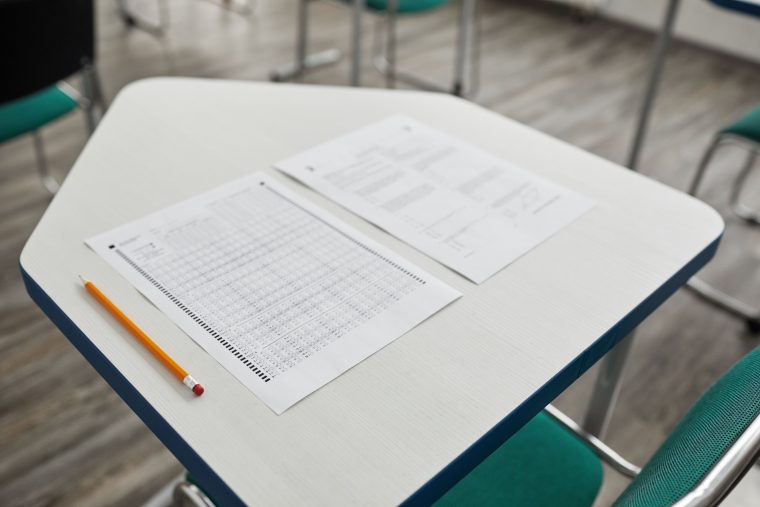
Full-length mock tests are the best simulation of the real exam you will get before test day. But most students waste them by treating them as practice sets instead of dress rehearsals. A well planned Full Length Mock Test Strategy will not only evaluate your knowledge but also prepare your mind and body to perform under the exact pressure, timing and fatigue that you will be facing on your exam day.
Here is a full practical method to try full length mocks the right way.
1. Treat each mock as if it is the real exam.
The biggest mistake students make is to treat the mocks casually, e.g. taking a break for a drink, looking at their phones or doing the test over two sittings. That totally defeats the purpose.
- Do the mock in one sitting, timing it the same as the real exam.
- Practice in the same room, using the same seating and stationery you will use on the day of the exam.
- No telephone. No music. No interruptions.
This is what platforms like Testegy are all about. The idea is to mirror the interface and timing of real exams so students get used to the real thing, not a watered-down version of it.
2. Pick the Right Section Order
Before you even start the clock, decide the order in which you’ll tackle sections. This should never be a last minute decision.
- I don’t know if it’s the same one but maybe it is. Early wins help build momentum and steady nerves.
- Don’t leave your weakest section until the end, when you’re too tired – save it for when you still have enough brain power.
- If the exam permits you to jump around between sections, do a quick scan to see which section looks lighter on that particular day—question difficulty can vary from exam to exam.
Follow this order in multiple mocks so that it becomes automatic when you sit in the real exam.
3. Master Time Management Section-Wise
Most marks are lost due to time management not knowledge. Make a section-wise and question-wise budget of your total time.
- Set a specific number of minutes per section, and adhere to that even if you’re in the middle of a question.
- Put a rough time limit per question in a section (e.g. 60-90 seconds for shorter questions, more for calculation-heavy ones).
- At the end keep 5-10 minutes buffer to review and mark unanswered questions.
- Watch your speed at quarter-marks (25%, 50%, 75% of section time) instead of just looking at the clock at the end.
4. Don’t Get Stuck on Tricky Questions
Ten easy questions can quietly take away one hard question. Make it a habit to triage questions on first pass.
- “Answer only what you’re sure of on your first reading.
- Flag tough or long questions for review instead of tackling them right away.
- Move on without guilt – a missed question costs you nothing if you come back to it later; a question you spend five minutes on costs you several easier marks elsewhere.
- Just go back to the marked questions after you’ve answered all the questions you’re sure of.
This one habit – practiced consistently across mocks with a platform like Testegy – is often the difference between a mediocre score and a top-percentile score, because it directly saves your accuracy and speed at the same time.
5. It’s not just about speed; it’s about accuracy too
In most of the competitive exams having negative marking, speed without accuracy is a losing strategy.
- Avoid guessing unless you can rule out at least two wrong answers.
- And always double-check units, signs, and intent of the question (i.e. “which is NOT true”) before finalizing an answer.
- Don’t let earlier mistakes undermine your confidence for the rest of the paper – compartmentalize each section.
- Also, focus on your accuracy percentage after every mock and not just your raw score. More accuracy is more important than one high score.
6. Go Through Each Mock Thoroughly
The real learning happens after the test, not during the test.
- Review all the wrong answers. Was it a conceptual gap, a silly mistake, or a time-pressure mistake?
- Write down questions you didn’t get to and why. Did you not know or did you not manage your time well?
- Keep a log of errors across mocks to get a pattern.
- After a few days do again only the questions you got wrong, without looking at the solution first.
7. Gradually simulate exam day conditions
As your exam date gets nearer, make your mocks more realistic:
- Practice at the same time of day as your actual exam time.
- Practice with the same break structure (if any) as in the real exam.
- Ease off on any external comforts (extra time, casual posture) you may have allowed yourself early on in prep.
Conclusion
A strong Full Length Mock Test Strategy is not about attempting more tests – it’s about attempting them with an intent, analyzing them honestly and refining your approach every single time. The four pillars that turn a mock test from a scorecard to a training tool are section order, time discipline, smart triaging of tough questions and an unwavering focus on accuracy.
The concept is the same whether you are preparing on your own or using a structured platform like Testegy to keep track of your progress over multiple mocks: walk into the real exam having already lived through it many times before.